
Introduction
Texas firm Arctic oil search: A small Texas-based oil firm is setting its sights on one of the most remote and contested frontiers on Earth. The company has announced a \$150 million plan to search for oil beneath the icy waters of the Arctic Ocean. The bold decision has reignited debates about energy security, environmental risks, and the high costs of drilling in one of the planet’s most fragile ecosystems.
The Arctic has long been considered a treasure chest of untapped natural resources. According to U.S. government estimates, the region may hold as much as 13% of the world’s undiscovered oil and nearly a third of its untapped natural gas reserves. Now, with global demand still rising, smaller players are joining the big energy giants in an effort to claim a share of this frozen fortune.
A Bold Move by a Small Player
The Texas firm behind the initiative is not one of the energy industry’s household names. Unlike ExxonMobil, Shell, or BP, this company operates on a much smaller scale. Yet its leadership believes that calculated risks can lead to significant rewards.
The \$150 million project is designed to fund seismic surveys, exploration permits, and early-stage drilling operations. The company’s executives describe the Arctic as a “next-generation energy frontier” and argue that the long-term value of oil reserves could far outweigh the upfront costs.
For small firms, success in such ventures can mean a meteoric rise in value. Industry analysts note that striking oil in the Arctic, even in limited quantities, could transform the company into a major player almost overnight.
The Promise of Arctic Oil
Energy experts believe the Arctic Ocean is one of the last great frontiers for fossil fuel exploration. With much of the world’s easy-to-access oil already extracted, attention has turned to challenging environments where technology and ambition intersect.
For countries and companies alike, Arctic oil presents both economic and strategic opportunities. Global demand remains strong despite a growing shift toward renewable energy. Nations and firms that control Arctic reserves could gain influence over future energy markets.
The Texas firm’s gamble reflects a broader trend of smaller companies entering high-stakes projects once dominated by the largest corporations. Advances in technology have lowered barriers to entry, making exploration more feasible for those with access to capital
Environmental Concerns Grow
While the business potential is undeniable, critics warn of significant environmental dangers. The Arctic is a fragile ecosystem, home to polar bears, walruses, seals, and migratory birds. Any major oil spill in these icy waters would be nearly impossible to contain due to extreme weather and remote geography.
Climate activists argue that pursuing new fossil fuel reserves in the Arctic undermines global climate goals. With the region already warming at more than twice the global average, drilling operations could accelerate melting and disrupt ecosystems.
Green groups are expected to challenge the project through legal action and public campaigns. Similar resistance forced larger oil companies to scale back or abandon Arctic projects in recent years.
Financial Risks and Rewards
Launching an Arctic oil search requires enormous financial resources. The \$150 million investment represents a significant commitment for a smaller firm. Beyond exploration, costs could escalate rapidly if commercial drilling proceeds. Specialized equipment, ice-resistant rigs, and logistical support are far more expensive than in traditional oil fields.
Still, the rewards could be transformative. If oil is discovered in commercially viable quantities, the firm could secure lucrative partnerships or buyouts from larger energy companies. Investors are watching closely, as even partial success could yield returns that dwarf the initial outlay.
Political and Legal Hurdles
The Arctic is not just an environmental and economic question—it is also a geopolitical one. Much of the region falls under overlapping claims by the United States, Russia, Canada, Norway, and Denmark. Securing drilling rights often involves navigating complex legal and diplomatic negotiations.
In the U.S., federal regulators have historically applied strict oversight to Arctic drilling projects. Permits can take years to obtain, and environmental impact assessments are exhaustive. The Texas firm will need to satisfy regulators while also fending off potential lawsuits from advocacy groups.
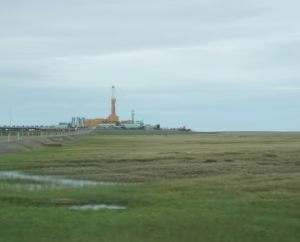
A High-Stakes Gamble
The decision by a small and firm to pursue a \$150 million And highlights the tension between global energy demands and climate concerns. For the company, the project represents a bold bet on the future of oil. Success could bring financial windfalls and elevate its status in the global energy landscape. Failure, however, could result in heavy losses and reputational damage.
The Arctic remains a place where opportunity and risk exist in equal measure. Whether this small Texas firm can overcome the challenges and strike black gold beneath the ice will be a story worth following
Conclusion
The Arctic Ocean has long tempted explorers, nations, and corporations with the promise of untapped energy wealth. Now, a small Texas firm is stepping onto this high-stakes stage with a \$150 million gamble. The world will be watching closely—not just for what it means to one company, but for what it reveals about humanity’s ongoing struggle to balance energy needs with environmental responsibility